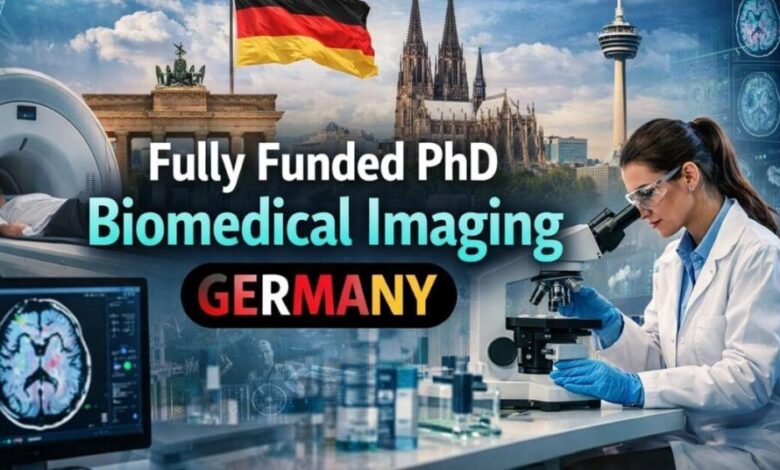
Fully Funded PhD Biomedical Imaging Germany 2026 The highly competitive doctoral program at the International Max Planck Research School – Molecular Biomedicine (CiM-IMPRS) is offered in association with the University of Münster’s Cells in Motion Interfaculty Center. The program provides future research scientists with comprehensive multidisciplinary training at the nexus of cell biology, biophysics, developmental biology, and clinical imaging.
The deadline to apply for the 2026 intake is May 1, 2026.
Programme Overview:
The CiM-IMPRS PhD programme offers 16 fully funded doctoral positions, each covering:
- Full funding for three years
- A competitive salary under a German employment contract
- Coverage of tuition and research-related costs
- Structured onboarding support, including visa guidance and relocation assistance
- Administrative and academic integration support
In addition to these positions, further PhD opportunities funded through institutional employment contracts may become available.
The programme is conducted entirely in English, making it accessible to international candidates without German language requirements.
Research Areas:
Within CiM-IMPRS, PhD research is conducted in a variety of biological and imaging-related fields, such as the following:
- Optical imaging with high resolution
- Technologies for in vivo imaging
- Neurobiology
- Immunology
- The biology of vessels
- Molecular and subcellular imaging
- Translational and clinical biomedical research
In order to solve challenging biological and medical issues, the curriculum places a strong emphasis on combining cutting-edge imaging methods with molecular and cellular biology.
Benefits of Fully Funded PhD Biomedical Imaging Germany:
- Complete Financial Security: Researchers can concentrate fully on their scientific work without worrying about money thanks to the program’s three years of full support, which covers tuition costs and delivers a competitive income under a German employment contract.
- World-Class Research Environment: Candidates have access to the Max Planck Society and Münster’s Cells in Motion Center, both of which are internationally renowned for their multidisciplinary cooperation and state-of-the-art biomedical imaging research.
- Advanced Biomedical Imaging Training: The PhD program gives researchers highly specialized technical and analytical capabilities by concentrating on translational imaging, in vivo methods, and high-resolution optical imaging.
- International and English-Medium Program: Since the entire program is taught in English, it attracts a broad global cohort and removes linguistic hurdles for PhD applicants from other countries.
- Excellent job Development Opportunities: Exposure to interdisciplinary research, collaboration with top scientists, and organized supervision greatly improve academic and industry job chances globally.
- Relocation and Administrative Support: The program makes the transition to Germany easy and accessible for foreign applicants by offering visa help, onboarding advice, and relocation support.
Check Also: KIT Germany Scholarships for International Researchers
Eligibility Criteria:
The programme welcomes applications from candidates of any nationality holding a Master’s degree in fields such as
- Biology and Biochemistry
- Biophysics
- Microbiology
- Molecular biology
- Associated biomedical or biological sciences
A strong interest in interdisciplinary research integrating imaging technologies with molecular and cellular systems is required of applicants. It is advantageous to have prior experience in fields like chemical biology, biomedical engineering, or computational imaging.
Although formal English test scores are not explicitly required, strong English proficiency is essential, as all training and research activities are conducted in English.
Institutional Strength and Reputation:
One of the most prominent research institutions in Europe is the Max Planck Society, and its International Max Planck Research Schools are renowned for turning out highly qualified PhD candidates.
Leading the way in imaging-based biomedical research is the Cells in Motion (CiM) cluster at Münster. It combines knowledge from physics, chemistry, biology, and medicine to facilitate teamwork and technology-driven research.
When combined, CiM and IMPRS provide an organized, research-focused setting backed by cutting-edge imaging facilities and capable academic oversight.
Application Process and Key Dates
Applications for the CiM-IMPRS PhD Programme 2026 must be submitted online only through the official portal:
Important Dates:
- Application opening: 2 March 2026
- Application deadline: 1 May 2026
- Programme start: October 2026 (earlier starts may be possible in selected cases)
Required Documents:
- Academic transcripts and certificates
- Curriculum Vitae (CV)
- Additional documents as specified in the online application system
Offline and email applications are not accepted.
Conclusion:
For early-career researchers looking for fully financed doctoral studies in Europe, the CiM-IMPRS PhD program is a great option. Candidates interested in the nexus of biology, medicine, and imaging technology will find it especially appealing due to its combination of employment-based funding, sophisticated imaging research, and multidisciplinary scientific training.
Is PhD program fully funded in Germany 2026?
Yes, the program is fully funded for three years. It includes tuition coverage, a monthly salary under a German employment contract, research support, and relocation assistance, allowing candidates to focus entirely on advanced biomedical imaging research work.
Do I need German language skills apply PhD?
No, German language skills are not required for this PhD programme. All courses, supervision, and research activities are conducted entirely in English, making it suitable for international students from diverse academic and linguistic backgrounds.
What salary is offered PhD Germany 2026?
Selected PhD candidates receive a competitive monthly salary under German employment contracts, typically around €2,700 to €3,200 depending on funding structure. This salary supports living costs, research activities, and relocation expenses in Germany.